Why StARTers?
The Aperitivo is an all Italian concept: it’s the after-work break, conceived to share the daily challenges with colleagues, friends or acquaintances. Usually accompanied by soft drinks and snacks, the “main course” remains the same: an informal conversation. In authentic Italian style, the conversation usually starts with a complaint and touches various topics loosely connected to the starting point: geopolitics, the state of society, the latest news, gossip… That’s why we decided it would be a perfect format to talk about art in an informal but pleasant way. Not just about art but of art. How it relates and reflects society as a whole, how an artist thinks and acts, wether art can or should be political but also how the art system works. These talks are led by artists, curators and professionals that start the conversation by sharing their experience, inviting the public to join in the conversation. To put it plainly: it’s the perfect art break (and it’s also free!).
This season’s menu
The StARTers ’26 season is all about The Peace Room Project: What can be the role of art in the present global situation that is often characterized by conflict, both interpersonal and intercultural? Can art prompt individual or collective thinking? Can it create a shared space of reflection, or even action? The talks will be centred around these questions. The goal is not to give an answer, but rather pose the same question from different points of view, exploring the complexity instead of trying to contain it or simplify it.
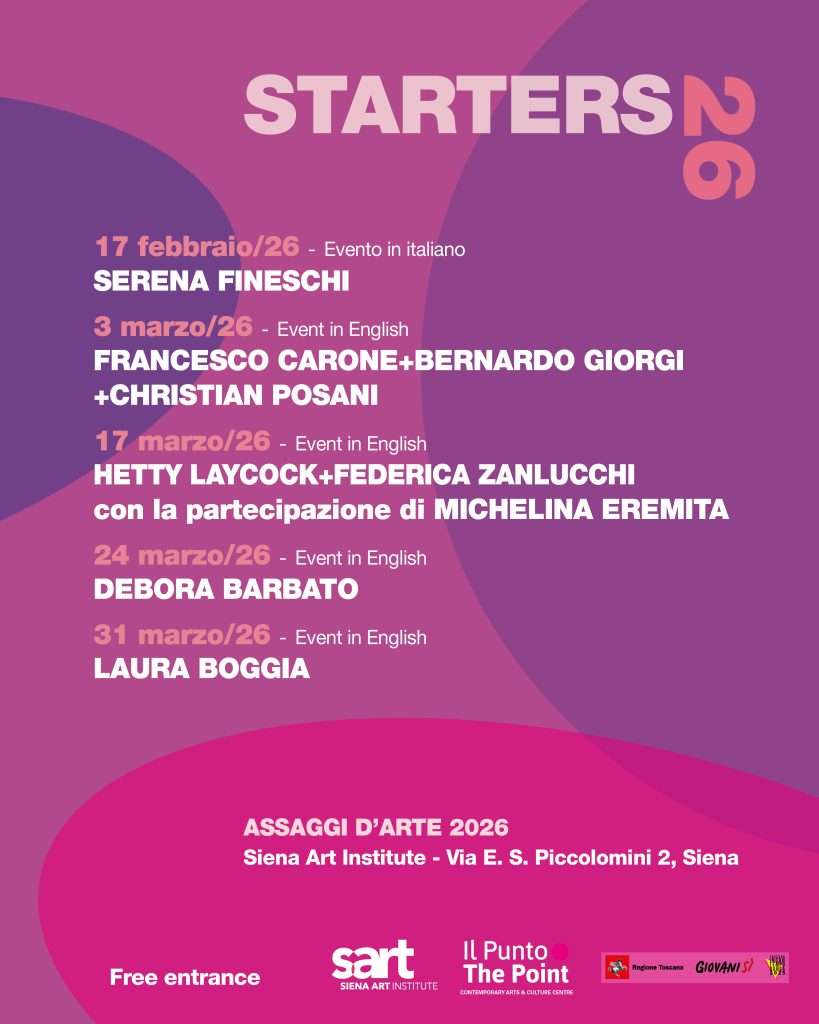
Meet this edition’s conversation starters
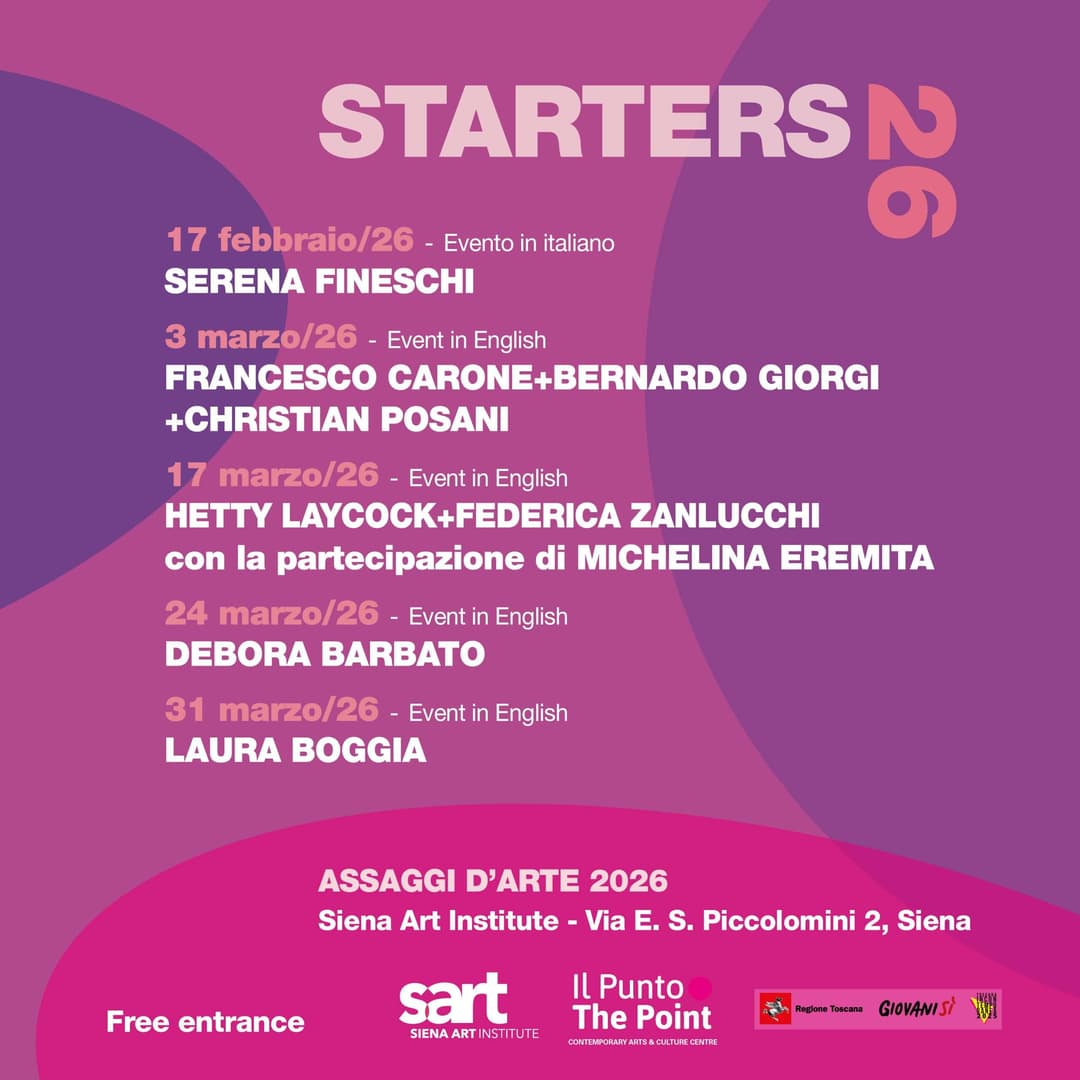
🍸17 february/26 – h18.00
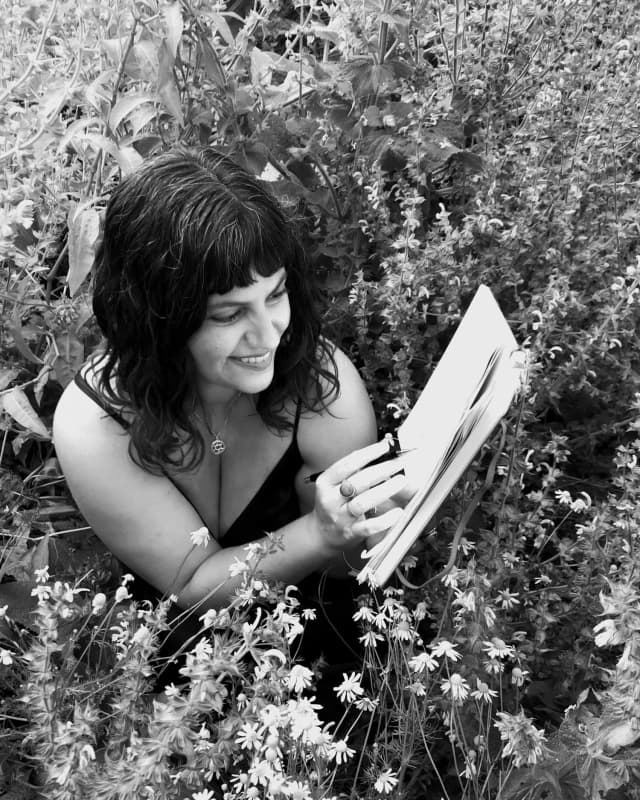
Serena Fineschi – in italian 🇮🇹
Serena Fineschi (Siena) lives and works between Siena and Brussels. She has a background in graphic design and contemporary art history. Her work, spanning photography, ceramics, assemblage, and site-specific installations, explores human relationships, memory, and the body as a symbolic terrain.
She is the co-founder of nomadic projects such as Grand Hotel and FONDACO, and in 2016 she established “Caveau,” a “vault” for ideas created within the walls of Siena. Fineschi has exhibited nationally and internationally, including at CENTRALE for Contemporary Art (Brussels), Santa Maria della Scala (Siena), Assab One (Milan), Palazzo Magnani (Reggio Emilia), the 15th Venice Architecture Biennale, the Milan Triennale, and Manifesta 12. Her artistic practice merges material experimentation with references to the past: from Sienese Trecento art to Flemish painting, investigating the tension between the sacred and the profane.
🍸3 march/26 – h18.00
Francesco Carone+Bernardo Giorgi+Christian Posani – in english 🇬🇧
Curators of the public art project Tempo Zulu, the talk will focus on the evolution of the project. Launched in 2004, Tempo Zulu consists in a constellation of engraved stone slabs set into the pavement, meant to be discovered slowly, almost by chance. Conceived by artist-curators Francesco Carone, Gregorio Galli, Bernardo Giorgi, and Christian Posani, the project emerged after funding for artist residencies at Santa Maria della Scala fell through. Instead, they chose to “fix” a shared time “Tempo Zulu,” or universal time into the city’s stone, linking public urban space with artistic and cultural production. The slabs, donated by invited artists, thinkers, and intellectuals to the Municipality of Siena, form a subtle path entrusted to word of mouth and local custodians. Their placement is carefully chosen to convey specific messages — such as the stone by chef Mario Avallone in Piazza Matteotti, once home to a fast-food outlet, or the contribution by Edi Rama with Anri Sala. Tactile and walkable, the works enrich Siena’s contemporary heritage and are accessible to the visually impaired. Never officially advertised, the removable stones are intentionally left without a map, encouraging both residents and visitors to discover what lies beneath their feet. The project engages with Siena’s 17 Contrade and local guides, embracing the idea that art must be lived rather than spectacularized.
🍸17 march/26 – h.18.00
Hetty Laycock+Federica Zanlucchi with the participation of Michelina Eremita – in english 🇬🇧
Hetty Laycock (Yorkshire, 1997) graduated from the Academy of Fine Arts in Venice in 2024 after completing her undergraduate degree at Falmouth University, Cornwall, in 2019. She has participated in international exhibitions and residencies, including a residency and solo exhibition at the Baltic Gallery for Contemporary Art, Poland (2024); the Tane Artist Residency, Nagahama, Japan (2025); and Una Boccata d’Arte in Valle d’Aosta, Italy (2025). She is currently an artist in residence at Bevilacqua La Masa, Venice.
Federica Zanlucchi was born in Trento in 1994. She obtained her First Level Diploma (2017) and Second Level Diploma (2020) in Visual Arts and Performing Arts, specializing in Painting, from the Academy of Fine Arts in Venice, in the studios of Carlo Di Raco and Martino Scavezzon. She currently lives and works in Venice.
Michelina Eremita è storica dell’arte e curatrice di progetti e di mostre oltre che di collezioni. È responsabile, presso il Museo Santa Maria della Scala (Siena), del Museo d’arte per bambini – di cui è cofondatrice – e dei relativi servizi educativi e didattici. Parallelamente alla sua attività di curatela, ha insegnato Storia dell’Arte Contemporanea presso diverse sedi come la Facoltà di Lettere e Filosofia dell’Università di Siena, sede di Arezzo.
🍸24 march/26 – h.18.00
Debora Barbato – in english 🇬🇧
Debora Barbato (1987) is a biologist and fixed-term researcher at the University of Siena specializing in soil biodiversity and terrestrial molluscs. She holds a Master’s degree in Biodiversity and Nature Conservation and a PhD in Earth, Environmental and Polar Sciences from the University of Siena. Her research explores the hidden diversity of small and often overlooked organisms and the interconnectedness of life within soil ecosystems. Her work also includes citizen science projects on urban biodiversity, encouraging people to observe nature and strengthen their connection with the living world. She collaborates with universities, museums and environmental organizations on biodiversity research, public engagement and environmental education.
The talk explores the idea that in nature nothing exists in isolation. Life is not simply a collection of separate individuals, but a complex network of relationships. From symbiosis to competition, from predation to parasitism, living organisms constantly interact with each other and with their environment, forming dynamic systems in which every element influences the others. Through examples drawn from the study of biodiversity, the talk will show how these relationships structure ecosystems and drive evolutionary processes. The theme of interconnectedness will also be linked to citizen science, in which networks of citizens contribute to observation and scientific knowledge, while at the same time developing a direct connection and reconnection with nature. Finally, a reflection will be proposed on the parallel with the world of art: just as organisms are part of ecological networks, artistic creativity also arises from relationships, influences, ideas, experiences, and shared contexts. Science and art, after all, both begin with the same gesture: observing the world, recognizing its connections, and passing it on to others.
🍸31 march/26 – h.18.00
Laura Boggia – in english 🇬🇧
Laura Boggia lives and works in Genoa. Her practice spans writing, art education, and curatorial work. She holds a Master’s in History of Art from the University of Genoa, where she researched subversive art practices in the twentieth and twenty-first centuries and developed a particular interest in participatory art and the social dimension of contemporary art. She has collaborated with institutions in Genoa and London, leading workshops for museums and art organisations, including Bold Tendencies, the Museum of Brands, the Luzzati Museum, Villa Croce Museum, and Alle Ortiche Festival, and working with galleries. She has written reviews and interviewed international artists for Juliet Art Magazine. After professional training in Creative Writing and Digital Content Production, she produced web content for the historic Milan-based art collective Studio Azzurro. She teaches Italian in middle school following the Writing and Reading Workshop (WRW) methodology. Since 2015, she has been part of Collective Task, an international art and poetry collective founded by Robert Fitterman.
The talk will focus on her experience across curating, art writing, education, and collective practices, highlighting projects developed both independently and collaboratively, including work with international collectives and exhibitions in unconventional spaces. It will explore the role of words in the arts as tools for critique, access, and meaning-making, alongside their limits and possibilities. Through examples from curatorial work, editorial practice, and workshops, the talk will reflect on art as a process of dialogue, networking, and shared experience, as well as on the relationship between visual practice, language, and audience engagement.
How to join
StARTers is and has always been free and open to all! See you on Tuesday at 18.00 at Il Punto/The Point!
Don’t forget to follow us on Social Media!

StARTers26 has been created for THE PEACE ROOM project with the contribution of the Region of Tuscany and GiovaniSì within the Toscanaincontemporanea2025 program.